
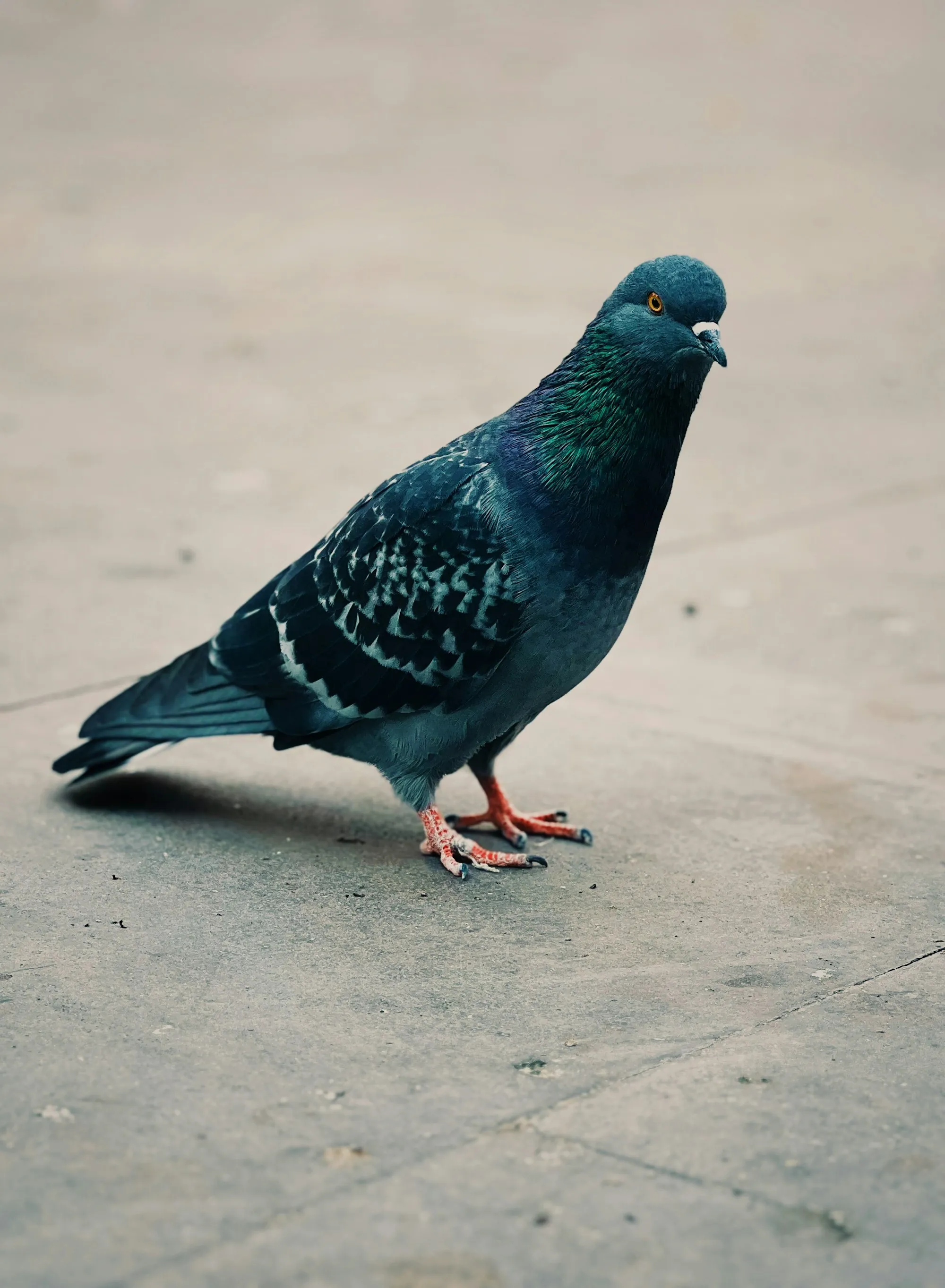
Pigeons under solar panels are one of the most common rooftop problems on south suburban homes, and Hazel Crest is no exception. The gap between a roof-mounted array and the shingles is dry, shaded, sheltered from wind and hard for predators to reach. To a pigeon, that is a near-perfect nesting ledge. Once a pair settles in, more tend to follow, and the space fills with nests, droppings and debris that sit directly on your roof.
This guide covers the signs that birds have moved in, the damage they can cause, and how critter guard mesh seals the array so they cannot get back underneath.
Why pigeons choose the space under solar panels
Pigeons choose the space under solar panels because it gives them everything a ledge on a building does, with a roof over their heads. Feral pigeons are adapted to living on structures, and the few inches of clearance under an array create a long, protected shelf that is warm in cold weather and shaded in summer.
They also tend to stay put. The Illinois Department of Public Health notes that visual and auditory scare tactics are less likely to work on pigeons than on other birds, and that feeding can increase the number of pigeons and pigeon problems in an area. A neighbor scattering bread on a patio, a spilled bird feeder or easy access to food nearby can make an array more attractive than it already is.
Five signs pigeons are nesting under your panels
The clearest sign of pigeons under solar panels is activity at the edge of the array: birds flying in and out of the gap, usually at the low edge or the sides. Other signs are easy to spot from the ground once you know to look.
- Cooing or scratching overhead. Pigeons are noisy roommates, and the sound often carries into upstairs rooms, especially early in the day.
- Droppings on the roof, gutters and patio. Streaks below the array, on the siding, or on walkways and cars parked near the house are a strong clue.
- Twigs and nest material at the array edge. Sticks, feathers and debris poking out from under the panels mean birds are building inside.
- Birds perched on the panel frames. Pigeons often line up along the top of an array before slipping underneath.
- Clogged gutters or downspouts. Nest material and droppings wash off the roof and collect in gutters below the array.
If you see more than one of these, assume the birds are already established under the array rather than just visiting.
What pigeons can do to the roof and the solar system
Pigeons can damage the roof, the solar wiring and the area around the house. The harm builds slowly, which is why it often goes unnoticed until a reroof or a leak brings someone up the ladder.
Moisture held against the shingles
Nests, droppings and blown leaves pack into the space under the panels and hold dampness against the roof surface. That material stays wet long after a rain, and in a Cook County winter it can freeze and thaw repeatedly in place. Debris that dams water around roof penetrations is the last thing a roof needs.
Wiring and connectors
The underside of an array carries wiring and connectors. Nest building can tug and pack material around those components, and the debris adds weight and moisture where you do not want either. Keeping the space clear protects the parts that keep the system producing.
Droppings and health concerns
Accumulated droppings are more than a mess. The Wildlife Illinois resource, authorized by the Illinois Department of Natural Resources, describes large roosting piles of droppings as both unsightly and a potential human health hazard. The Centers for Disease Control and Prevention explains that histoplasmosis is caused by breathing in spores of a fungus that lives in soil and also spreads in bird and bat droppings that mix in soil. Homeowners should not climb up to scrape out droppings by hand, both for health reasons and because working on a roof around an energized array is unsafe.
Why scare devices and quick DIY fixes fall short
Scare devices and improvised barriers rarely solve pigeons under solar panels, because they do not close the gap the birds are using. Plastic owls, reflective tape and noise makers are the usual first try, and as IDPH points out, pigeons are less bothered by visual and auditory scare tactics than other birds. After a short while, the birds treat a fake owl as part of the scenery.
Improvised barriers bring their own problems. Loose chicken wire stuffed around the edge tends to sag, rust and leave openings at the corners. Foam, sealant or adhesive pushed into the gap can trap moisture against the roof and is difficult to remove cleanly at the next reroof. Anything screwed or drilled into a panel frame risks damaging the panel itself. And every one of these fixes means someone on a ladder or a pitched roof, working around wiring that can carry voltage whenever daylight reaches the array.
The pattern to avoid is a partial fix that leaves one opening. Pigeons will find it, and the nest simply moves a few feet along the array.
How critter guard keeps pigeons out
Critter guard is a mesh barrier fitted around the outer edge of the solar array that closes the gap between the panels and the roof. With the edge sealed, birds and other animals simply cannot get underneath.
The approach matches what public health guidance recommends for pigeons in general. The Illinois Department of Public Health lists exclusion, including screening, netting and mesh, among the ways to keep pigeons off structures. Critter guard applies that idea to a solar array specifically. The mesh is held in place with clips that attach to the panels, so no panel is drilled and the roof is not punctured to install it.
Clear first, then seal
The order matters. Any nests, droppings and debris under the array have to be cleared out before the mesh goes on. Sealing the edge over existing nest material traps the mess, and the moisture, against the roof.
Check for active nests and local rules
Feral pigeons are not protected by state or federal law, according to the same IDPH guidance, but it also advises checking with local authorities because local ordinances may still apply. It also helps to confirm the nesting birds really are pigeons and not a native species before anything is removed.
When to add critter guard: now or at the reroof
The right time to add critter guard is either as soon as you see the signs, or during a detach and reset when the array is already off the roof. Both work. They just solve slightly different problems.
If pigeons are already nesting and your roof is in good shape, fitting critter guard now stops the damage from building. If a new roof is coming anyway, the reset is the easiest moment: the panels are off, the whole area underneath is exposed, and the mesh can go on as the array goes back up. A new roof in Hazel Crest needs a permit, too; the Village of Hazel Crest Inspectional Services lists roofing among the common home improvements that require one, whether a homeowner or a contractor does the work.
Deciding what to do about the birds on your roof
Start with what you can see from the ground. If birds are going in and out of the array edge, nest material is showing, or droppings are piling up below, the space under your panels is already occupied, and waiting usually means more birds and more debris. Next, think about the roof. A roof with plenty of life left is a good candidate for critter guard on its own. A roof nearing replacement is a strong reason to pair the mesh with the reset, so the job is done once on a clean, new surface.
Solar Panel Removal Hazel Crest fits solar panel critter guard as its own job or as part of a full solar panel detach and reset for homes in Hazel Crest, Markham, Country Club Hills and Homewood. You can read more about us on our home page.